Hundreds of inspection reports. No view of the asset fleet. And an audit on the way.
Lucens Integrity automatically turns hundreds of PDF inspection reports into a structured, per-asset history, ready for audits and asset management. On-site, no cloud.
One Monday morning, a piece of equipment stops, and production with it. Every hour costs. Eventually the warning sign turns up: it was there in black and white, in an inspection report paid for two years earlier. Filed away somewhere, never re-read. The data existed. It served no purpose.
The same asset fleet, two realities.
Before
- Reports scattered by provider and by format
- No consolidated history per asset
- True fleet condition unknown, decisions made blind
- Audit prepared in a rush, digging through archives
After
- Every report linked to its asset
- History rebuilt, dated, traceable
- Health index and deadlines under control
- Audit file in one click, with source to back it
A regulated asset fleet, inspected by dozens of providers.
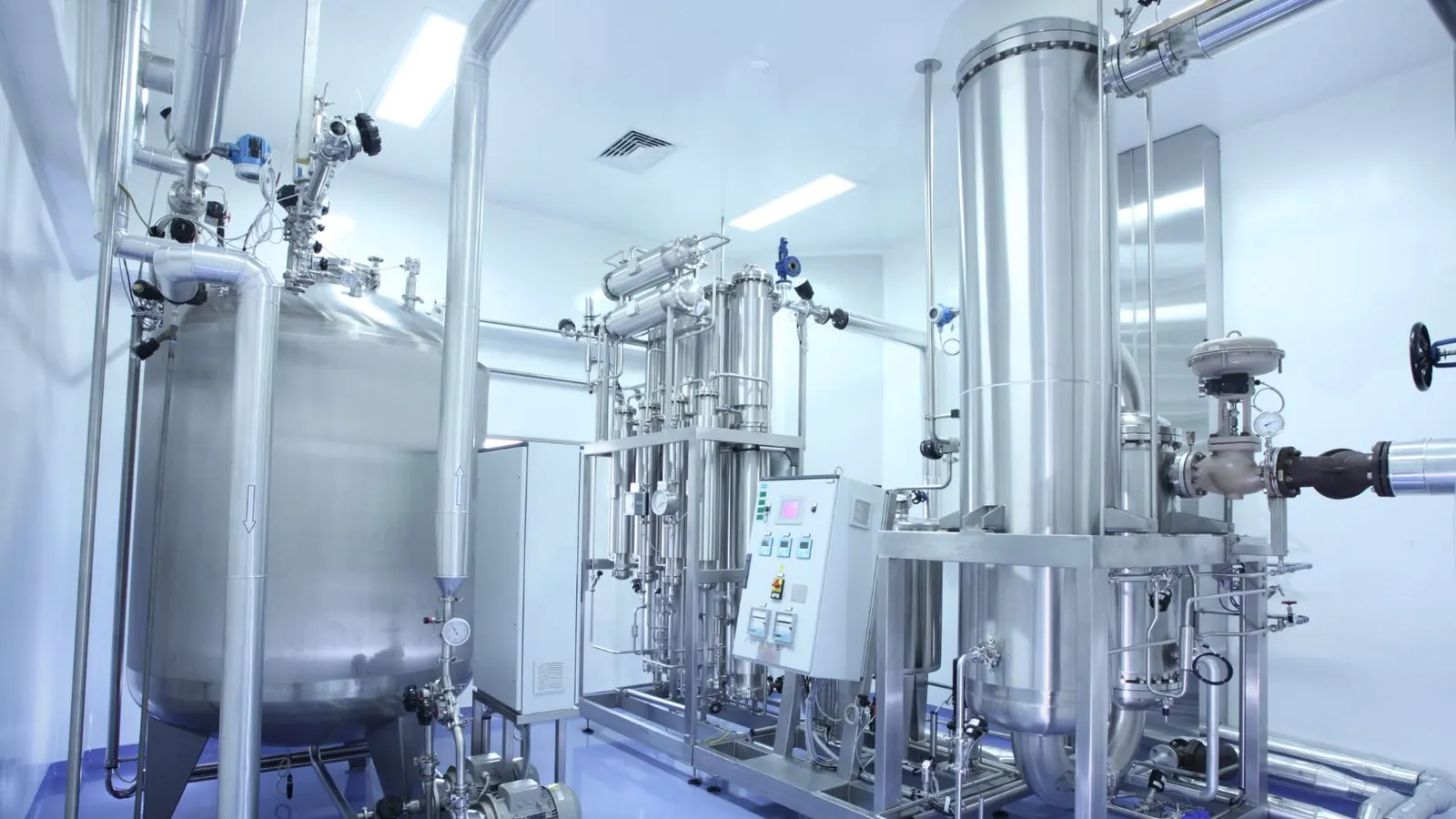
A multi-site food group with several processing plants. Each site holds a fleet of technical, regulated assets, some of which fall under pressure-equipment monitoring (French Order of 20 November 2017).
- Steam generators, autoclaves, heat exchangers, pressure vessels, steam piping, silos, filtration lines.
- Outsourced inspection: several dozen providers per group (approved pressure-equipment bodies, inspection firms, NDT subcontractors).
- Each delivers its findings in its own format — PDF, scan or in-house template — with no common structure.
The problem isn't a lack of inspections. It's the inability to use them.
The inspections are done, and paid for. But several hundred reports per year and per site arrive as a fragmented stream, archived at group level with no per-asset indexing.
Yet the regulations require the opposite: asset-by-asset monitoring, with an operating file and a dated register (Article 6 of the Order of 20/11/2017). The data exists, but it sleeps in files: the true condition of a piece of equipment cannot be produced in a few minutes.
Across multiple sites, without consolidation, decisions rest on estimates, which raises the risk of unplanned downtime and extra costs.
From a PDF received to an asset under control.
Lucens Integrity: local software that reads, sorts and manages.
Installed on-site, no cloud, AI-powered. It reads existing reports, extracts the facts, sorts them by asset and rebuilds each item's history, then produces dashboards and fleet health indicators.
Precision is non-negotiable, and that is what makes the indicators defensible to an auditor: the AI extracts facts as written, deterministic formulas compute the indicators, and every figure stays traceable back to its source document.
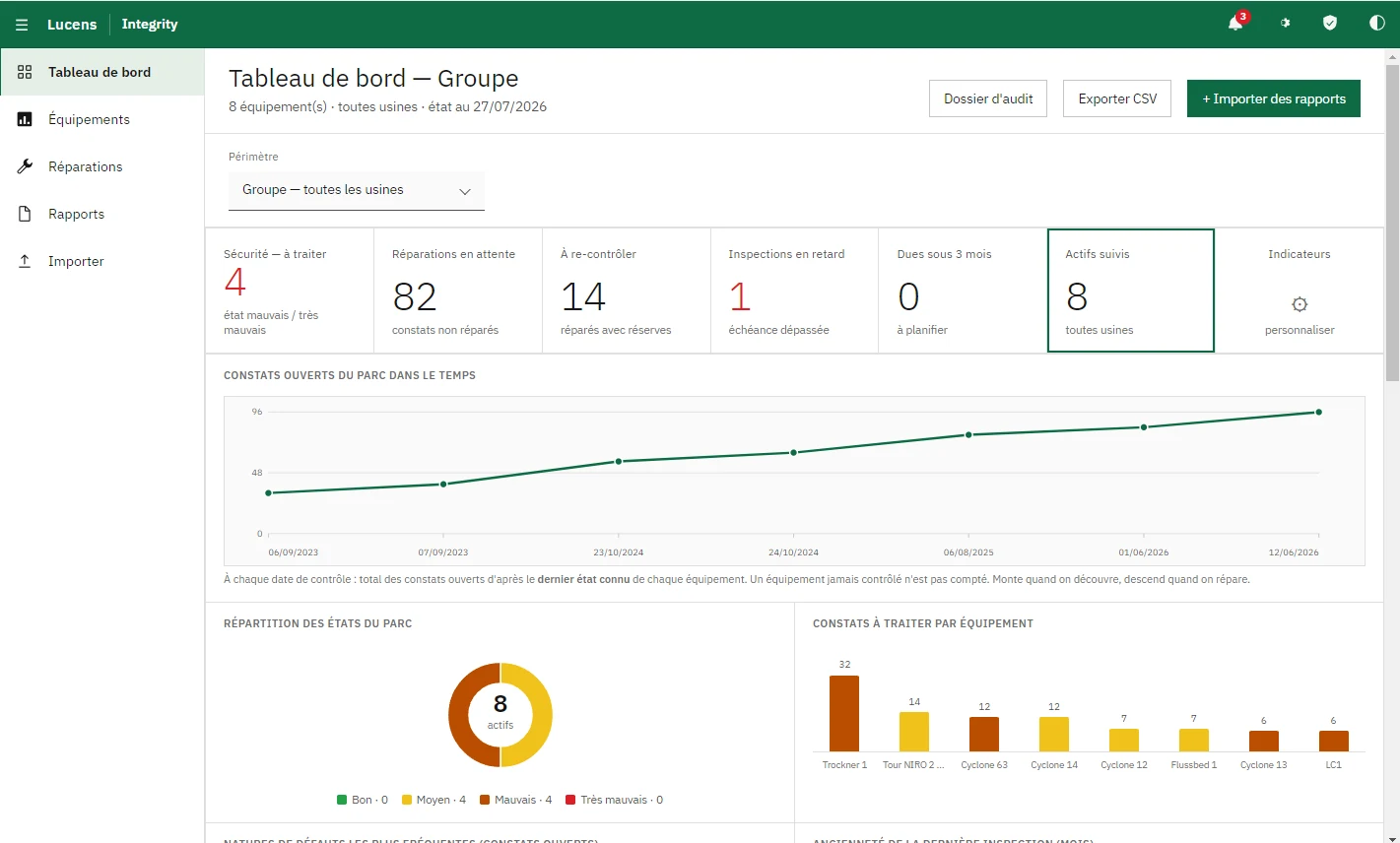
Actual screenshot: the fleet-condition dashboard in Lucens Integrity
One piece of equipment, its full technical memory.
Illustrative example
What you manage — at asset, site and group level.
Completion rate of due inspections
Deadlines met divided by deadlines due, per site. The direct indicator of regulatory exposure, demonstrable in an audit.
Upcoming inspection load (next 6 months)
Regulatory deadlines per month over the next six months, plus the next deadline per asset, to anticipate peaks instead of enduring them.
Condition rating / health index 0-100
A composite score per asset covering surface, structural and hygiene defects, with a 12-month trend. An asset with no crack can still rate very poor on its structure.
Remaining life and corrosion rate
Computed over the thickness time series (UT measurements). Shown as insufficient data, never estimated, when the series is missing.
Open anomalies by severity
Unresolved non-conformities and the breakdown of verdicts — approved, approved with reservations, or not repaired — so a defect repaired with reservations is never treated as closed.
Fleet blind spots
Assets with no report for longer than the planned interval. The missing inspection becomes visible and quantified, per site and per group.
Report availability for audit
For every asset and every deadline, the linked source record, openable and printable. The extract-compute-summarise chain makes each indicator defensible.
A fleet under control, audits prepared, decisions backed by evidence.
Less stress before audits
The file is ready ahead of time, no last-minute scramble.
No more manual searching
An asset's full history opens in seconds.
Faster decisions
Based on traceable, dated facts.
A clear view of the fleet
The real condition of every asset, at any time.
Risk under control
No more regulatory blind spots or missed deadlines.
What the software does, and what it does not.
The indicators are only as good as the reports provided. Lucens Integrity extracts facts as written and never guesses. Any missing information is flagged “to be verified”; any inconsistency (contradictory measurements, unidentified asset, duplicate) is raised for human review.
When a measurement series is insufficient, the system shows “insufficient data” rather than producing an unfounded figure. It structures, computes and alerts: it replaces neither the reliability of the source, nor the expert's judgement, nor the inspections carried out by approved bodies.
The texts that govern asset monitoring.
| French Order of 20 November 2017 (in-service monitoring of pressure equipment) | Reference text in force since 1 January 2018 (JORFTEXT000036128632), implementing Articles R.557-14-1 et seq. of the French Environment Code. It consolidates requirements previously spread across many orders. |
| Pressure-equipment intervals (inspection and requalification) | Periodic inspection every 4 years max, reduced to 2 years for steam generators and autoclaves; requalification every 10 years, cut to 6 years for toxic or corrosive fluids. Default values are adjustable via a recognised inspection plan, to be checked asset by asset. |
| Article 6 of the Order of 20/11/2017 (LEGIARTI000036131075) | An operating file with a dated register of all operations and an up-to-date equipment list; attestations kept for at least the maximum period between two requalifications, other documents for the equipment's lifetime. |
| NDT, COFREND certification (EN ISO 9712) | Non-destructive testing carried out by agents certified across three levels, per method, with certification renewed every 5 years. |
| IFS Food version 8 | GFSI-recognised private standard, mandatory for audits since 1 January 2024. Chapter 4.16 Maintenance, 4.17 Equipment, 4.18 Traceability (Knock-Out requirement). Not a legal obligation. |
| BRCGS Food Safety Issue 9 | GFSI-recognised private standard, audits since 1 February 2023. Clause 4.7 Maintenance: a documented planned-maintenance programme covering premises and equipment, with records. Not a law. |
| ISO 55001:2024 (asset management) | Current edition replacing ISO 55001:2014. A certifiable but voluntary asset-management-system standard; the organisation defines its own scope. |
| GDPR, Regulation (EU) 2016/679 | Applies even in a local deployment as soon as personal data is processed. The operating group is the data controller; a local vendor with no access to the data is not a processor, but any support access must be governed (Article 28). |
Your fleet deserves to be under control, not lost in the archives.
Get a diagnosis of your fleet and a demonstration of Lucens Integrity on your own reports.