
Hundreds of inspection reports. No view of asset condition. And the audit is coming.
How a food manufacturer moved from a pile of scattered reports to a reliable, steerable view of its asset integrity. A read for maintenance, methods, quality and technical-management leaders.

The problem is not a lack of checks. It is that their results never become a usable view of the asset base.
- An industrial site accumulates hundreds of inspections a year, carried out by dozens of contractors, in as many formats.
- These reports are paid for then archived, rarely linked to the equipment they describe. The per-asset history exists nowhere.
- Consequences: blind decisions, regulatory blind spots, last-minute audits, breakdowns whose warning sign was asleep in a PDF.
- The real challenge: turning this pile of documents into asset intelligence. That means a reliable, dated and traceable condition of every piece of equipment over time.
- This is the capability an Asset Integrity Intelligence platform like Integrity Loop brings: steer, anticipate, prove.
- 6:12 am
An unusual noise on line 3. Nobody dwells on it : the shift changes ten minutes later.
- 6:40 am
The equipment stops dead. Production stops with it. Every hour of downtime costs several thousand euros.
- 9:15 am
The maintenance manager looks for the heat exchanger's history. Nothing in the CMMS. The paper archives have to be reopened.
- 11:30 am
The report turns up : an inspection paid for two years earlier already flagged local corrosion to watch.
The data existed. Nobody looked at it again. This is not a checking problem : it is a memory problem.
- 2:20 pm
During a clean-in-place (CIP) cycle, a mixer blade shows a worn patch on its coating. Nothing is logged.
- 6 weeks later
A batch is put on hold : the outgoing bacteriological control reveals unexpected contamination.
- The investigation
The worn blade is identified. A micro-defect in the coating created a niche where a biofilm could grow, invisible to the eye.
- The finding
The wear was noted on an inspection report... but it was not linked to this specific tank's history.
Once again, the data existed. It just wasn't connected to the asset it concerned.
Asset integrity: what are we talking about?
Before talking about a tool, we need to share the same definitions. These are the concepts every industrial asset manager works with, often without naming them.
Asset integrity (Asset Integrity)
The ability of a piece of equipment to operate safely and at the expected performance throughout its life. Managing it means knowing the real condition of every asset over time.
Asset integrity management (Asset Integrity Management)
The methods that maintain this ability. Planned inspections, degradation tracking, an up-to-date register. Repair or replacement decisions are grounded in data.
Asset intelligence (Asset Integrity Intelligence)
The stage where scattered inspections become decision-ready information. History rebuilt per asset, health index, anticipated due dates, prioritised risks. This is the positioning of Integrity Loop.
Mechanical integrity (Mechanical Integrity)
The area covering pressure equipment, piping and vessels. It tracks thicknesses, corrosion and remaining life, consistent with the inspection codes (API 510, 570, 653).
Risk-based inspection (Risk-Based Inspection, RBI)
An approach that prioritises inspections by the risk of each piece of equipment. It crosses probability of failure with consequence, rather than a uniform schedule (API 580, 581).
Remaining life (Remaining Life Assessment)
The time left before a piece of equipment reaches its usable limit. The calculation starts from the measured degradation rate, most often corrosion tracked by thickness measurements (UT).
Want a quick demo?
15 minutes to see Integrity Loop on a case close to yours.
The checks are done. The asset base, though, is not under control.
A multi-site food manufacturer, several processing plants. Each site holds a fleet of technical, regulated equipment. Part of it falls under the in-service monitoring of pressure equipment (French Order of 20 November 2017).
- Steam generators, autoclaves, heat exchangers, pressure vessels, steam piping, silos, filtration lines.
- Checks outsourced: several dozen contractors per group, approved pressure-equipment inspection bodies, inspection firms, non-destructive testing (NDT) subcontractors.
- Each delivers its findings in its own format, PDF, scan or in-house template, with no common structure.
The inspections are carried out, and paid for. But several hundred reports a year per site arrive as a fragmented stream, archived at group level with no indexing by asset.
Yet the regulations require the opposite: asset-by-asset tracking, with an operating file and a dated register (Article 6 of the Order of 20/11/2017).
The data exists, but it lies dormant: the real condition of a piece of equipment cannot be produced in a few minutes. Across multiple sites, without consolidation, decisions rest on estimates. The risk of unplanned downtime and extra cost rises, silently.
Five risks carried by an unsteered asset base.
- Safety
A pressure item whose degradation goes unnoticed puts people and the production line at risk.
- Regulatory compliance
In-service monitoring of pressure equipment requires an operating file and a dated register per asset. A lack of traceability is a non-conformity.
- Quality audit
IFS Food and BRCGS require a documented maintenance programme and records. Without a consolidated history, the evidence is missing.
- Cost of downtime
An unplanned stoppage costs in lost production, emergency repairs and a knock-on effect on deliveries.
- Investment decisions
Without a real view of the asset base, extending or replacing a piece of equipment is decided by guesswork. So often badly.
The asset families tracked across this base.
Beyond food manufacturing: Integrity Loop can cover practically any static asset base on an industrial site.
The same asset base, two realities.
Before
- Reports scattered, by contractor and by format
- History not consolidated per piece of equipment
- Real condition of the asset base unknown, blind decisions
- Audit prepared at the last minute, digging through archives
After
- Each report attached to its equipment
- History rebuilt, dated, traceable
- Health index and due dates under control
- Audit file in one click, source to hand
An Asset Integrity Intelligence platform, installed on your premises.
The group deployed Integrity Loop across its sites. It uploaded its inspection reports into the platform, several hundred documents accumulated over several years.
Within weeks, it had a precise, asset-by-asset view of its equipment base. That view was rebuilt from those existing inspections.
Installed on-premise, with no cloud, the platform works on the existing reports.
- It extracts the facts as written and sorts them by asset.
- It rebuilds the history of each piece of equipment.
- From this it derives health indicators, due dates and priorities.
- Deterministic formulas calculate the indicators.
- Every figure stays traceable back to its source document.
This is what makes the indicators defensible before an auditor.
Thousands of scattered technical documents become a complete, reliable and usable view of the industrial asset base. This is the central benefit: a decision-making capability.
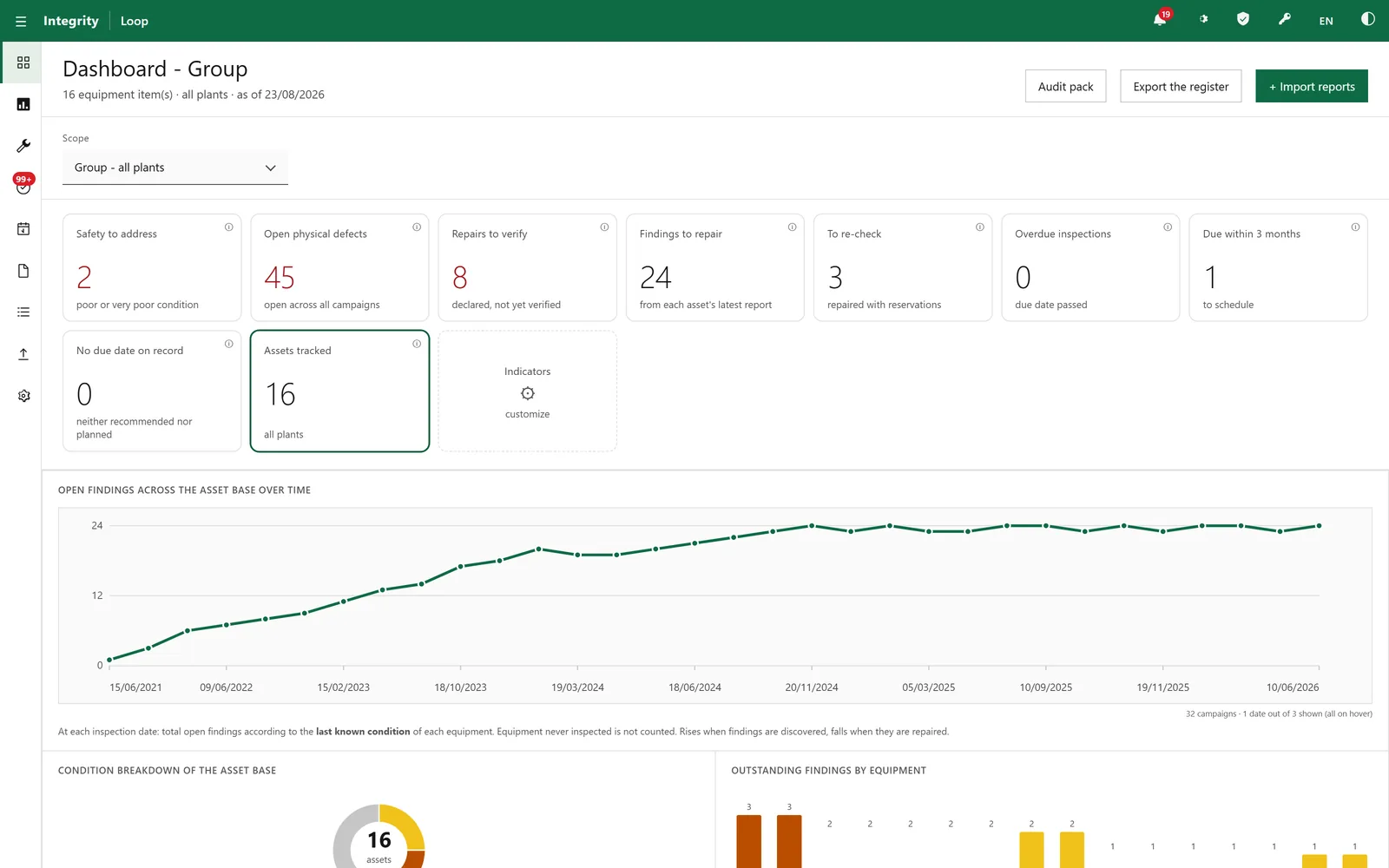
Real screenshot: the asset-base condition dashboard in Integrity Loop.
This dashboard could show your asset base.
Request a demonstrationFrom a PDF received to an asset under control.
One piece of equipment, all its technical memory.
This is where corrosion becomes readable: as a series, not report by report. Three thickness measurements are enough to estimate a degradation rate and a remaining life.
Illustrative example
Overlay inspections, see how defects evolve.
Every defect is positioned on the equipment. From one visit to the next, the map overlays: a defect that's growing, a new one, a zone that's stable. Especially telling on large surfaces: tanks, spray dryers, cyclones, silos, sterile tanks.
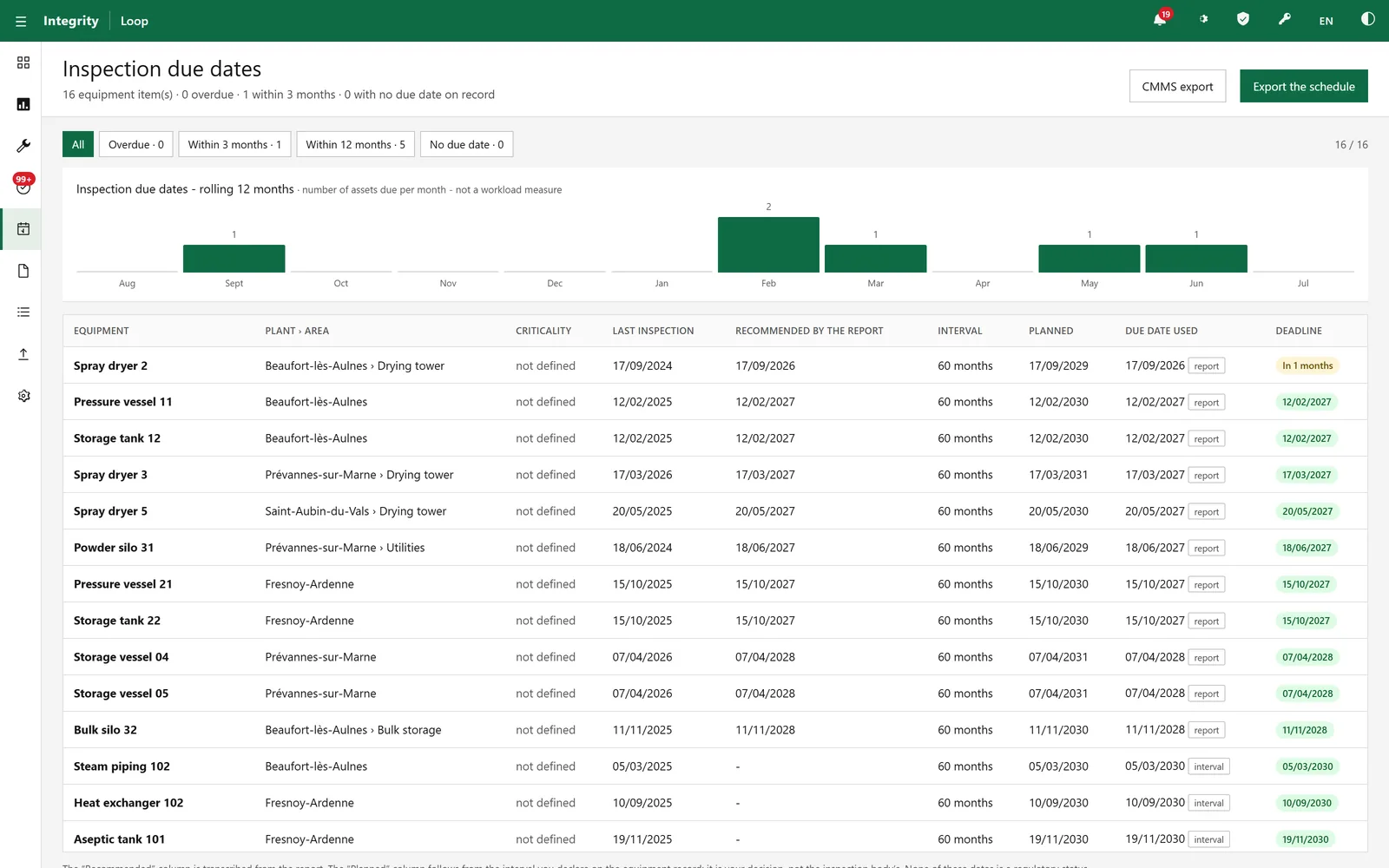
Real screenshot: an equipment's defect map, overlayable across visits.
What you steer, at asset, site and group level.
- Completion rate of inspections due
Due dates met divided by due dates owed, per site. The direct indicator of regulatory exposure, demonstrable in an audit.
- Upcoming inspection load (next 6 months)
Regulatory due dates per month over the next six months. Plus the next due date per asset, to anticipate the peaks.
- Asset health index (0 to 100)
A composite score per asset combining surface, structural and hygiene defects, with a 12-month trend. An asset with no crack can still be rated very poor on its structure.
- Remaining life and corrosion rate
Calculated over the thickness time series (UT measurements). Shown as 'insufficient data' when the series is missing.
- Open anomalies by severity
Unresolved non-conformities, with the breakdown of verdicts: approved, with reservations, not repaired. A defect repaired with reservations no longer passes as closed.
- Blind spots in the asset base
Assets with no report for longer than the planned interval. The missing check becomes visible and quantified, per site and per group.
- Report availability for audit
For each asset and each due date, the source record attached, openable and printable. The chain of fact, formula, synthesis makes every indicator defensible.
Real screenshot: every indicator shown is configurable, nothing is forced on you.
Why neither a spreadsheet, nor a document manager, nor an EAM is enough.
Each existing tool solves part of the problem. What they miss is rebuilding the integrity of the asset base from the reports. It is a category of its own.
Centralise the reports
Attach each report to the asset
Rebuild the per-equipment history
Health index and remaining life
Detect assets with no check
Traced audit file, source to hand
On-premise processing, no cloud
Steering your asset integrity well, with or without software.
Best practices
- Keep a register per asset, not per contractor or per year.
- Index each report to its equipment on receipt, not the day before the audit.
- Track due dates on a rolling six-month view, to anticipate the peaks.
- Keep the source document linked to each indicator, to make it defensible.
- Prioritise inspections by risk (RBI), not by a uniform schedule.
- Date thickness measurements to calculate remaining life.
Common mistakes
- Archiving reports at group level, with no indexing by asset.
- Treating the audit as a one-off project rather than a permanent state.
- Treating a defect 'repaired with reservations' as closed.
- Trusting a figure without being able to trace it back to its source.
- Guessing a missing value instead of flagging it to verify.
- Confusing 'checks completed' with 'asset base under control'.
An asset base under control, audits prepared, decisions well-founded.
Search time cut down
A piece of equipment's history, which used to take hours to rebuild by hand, opens in seconds.
Costs avoided
Fewer unplanned stoppages: the degradation signal is caught before the breakdown, not after.
Audits without the stress
The compliance file is ready continuously: no more last-minute scramble before IFS or BRCGS.
Prioritised visibility, at every level
Group, site, workshop: each manager sees what matters to them, and knows what to tackle first.
An asset base like this one, with AI steering it for you.
Get in touchWhat the platform does, and what it does not.
The indicators are only as good as the reports supplied. Integrity Loop extracts facts as written, without guessing. Any missing information is flagged 'to verify'; any inconsistency (contradictory measurements, unidentified asset, duplicate) is escalated for human review.
When a series of measurements is insufficient, the system displays 'insufficient data' rather than producing an unfounded figure. It structures, calculates and alerts. It replaces neither the reliability of the source, nor the judgement of the expert, nor the checks carried out by the approved bodies.
The texts and standards that govern asset monitoring.
French Order of 20 November 2017 (in-service monitoring of pressure equipment)
The reference text in force since 1 January 2018 (JORFTEXT000036128632). It implements Articles R.557-14-1 and following of the Environment Code. It consolidates requirements previously spread across many separate orders.
Pressure-equipment intervals (inspection and requalification)
Periodic inspection every 4 years maximum, reduced to 2 years for steam generators and autoclaves. Requalification every 10 years, reduced to 6 years for toxic or corrosive fluids. Default values may be adjusted by a recognised inspection plan, to be checked asset by asset.
Article 6 of the Order of 20/11/2017 (LEGIARTI000036131075)
An operating file with a dated register of operations and an up-to-date equipment list. Certificates are kept for at least the maximum period between two requalifications. Other documents are kept for the life of the equipment.
API inspection codes 510, 570, 653
International reference codes for in-service inspection. API 510 for pressure vessels, API 570 for piping, API 653 for storage tanks. They serve as a benchmark for interval and remaining-life rules.
Risk-based inspection (API 580 / 581)
A recognised methodology for prioritising inspections by risk. Fed by a reliable per-asset history, it allows more frequent inspection of what warrants it, and less of what does not.
Non-destructive testing (NDT), COFREND certification (EN ISO 9712)
Non-destructive examinations carried out by certified agents. Three levels, by method, with certification renewed every 5 years.
IFS Food version 8
A private, GFSI-recognised standard, required for audits since 1 January 2024. Chapter 4.16 Maintenance, 4.17 Equipment, 4.18 Traceability. Not a legal obligation.
BRCGS Food Safety Issue 9
A private, GFSI-recognised standard, audits since 1 February 2023. Clause 4.7 Maintenance: a documented planned-maintenance programme covering facilities and equipment, with records. Not a law.
ISO 55001:2024 (asset management)
The edition in force, replacing ISO 55001:2014. A certifiable but voluntary asset-management system standard; the organisation itself defines the scope covered.
GDPR, Regulation (EU) 2016/679
Applies even in an on-premise deployment as soon as personal data is processed. The operating group is the data controller. The local software vendor that does not access the data is not a processor. Any support access must be governed (Article 28).
What manufacturers ask before deciding.
What is asset integrity management software?
It is software that rebuilds and maintains the real condition of every piece of equipment over time, from inspections. It goes further than document storage. It links each report to an asset and calculates health indicators. The asset base becomes steerable and auditable.
How is it different from a CMMS or an EAM?
A CMMS manages work orders and day-to-day maintenance. It does not read inspection reports or rebuild the integrity of the asset base. Integrity Loop focuses on the work management suites do not do, and sits alongside an EAM already in place.
Does Integrity Loop replace my inspection body?
No. Your inspection bodies carry out the checks. Integrity Loop reads their reports, structures them and tracks them over time. It does not perform the inspection: it becomes its memory and its steering.
What equipment can be tracked?
Pressure equipment, steam generators, autoclaves, heat exchangers, vessels and tanks, piping, silos and hoppers, filters, drying towers. In short, any equipment subject to periodic inspections.
How is remaining life calculated?
It starts from the dated series of thickness measurements (UT). The corrosion rate is derived from the trend. The remaining life follows, down to the minimum allowable thickness. Without a sufficient series, the system displays 'insufficient data' rather than an unfounded figure.
Is risk-based inspection (RBI) supported?
Yes, upstream. The platform makes the condition and trend of every asset visible. It supplies the raw material for an RBI approach (API 580/581), to inspect more often what warrants it.
Does my data go to the cloud?
No. The database and the reports stay on-premise, on your workstation or your network, with time-stamped backups. Inspection data stays with you.
How does the platform help prepare an IFS or BRCGS audit?
For each asset it brings together the history, the due dates and the source reports, and makes the audit file available in one click. The evidence is built continuously, not reconstructed at the last minute.
What happens if a report is incomplete or unreadable?
Missing data is flagged 'to verify' rather than guessed. An inconsistency is escalated for human review. Reliability comes before apparent completeness.
How long to get a first view of the asset base?
Importing and reading a first batch of reports is immediate. A new format needs a short calibration on your real documents. The first consolidated view arrives as soon as that first batch is processed.
Your asset base deserves to be under control, not in the archives.
Get a diagnosis of your asset base and a demonstration of Integrity Loop on your own reports.
