Local deployment
Reports and database on your own infrastructure.
Integrity Loop · Asset Integrity Management System (AIMS)
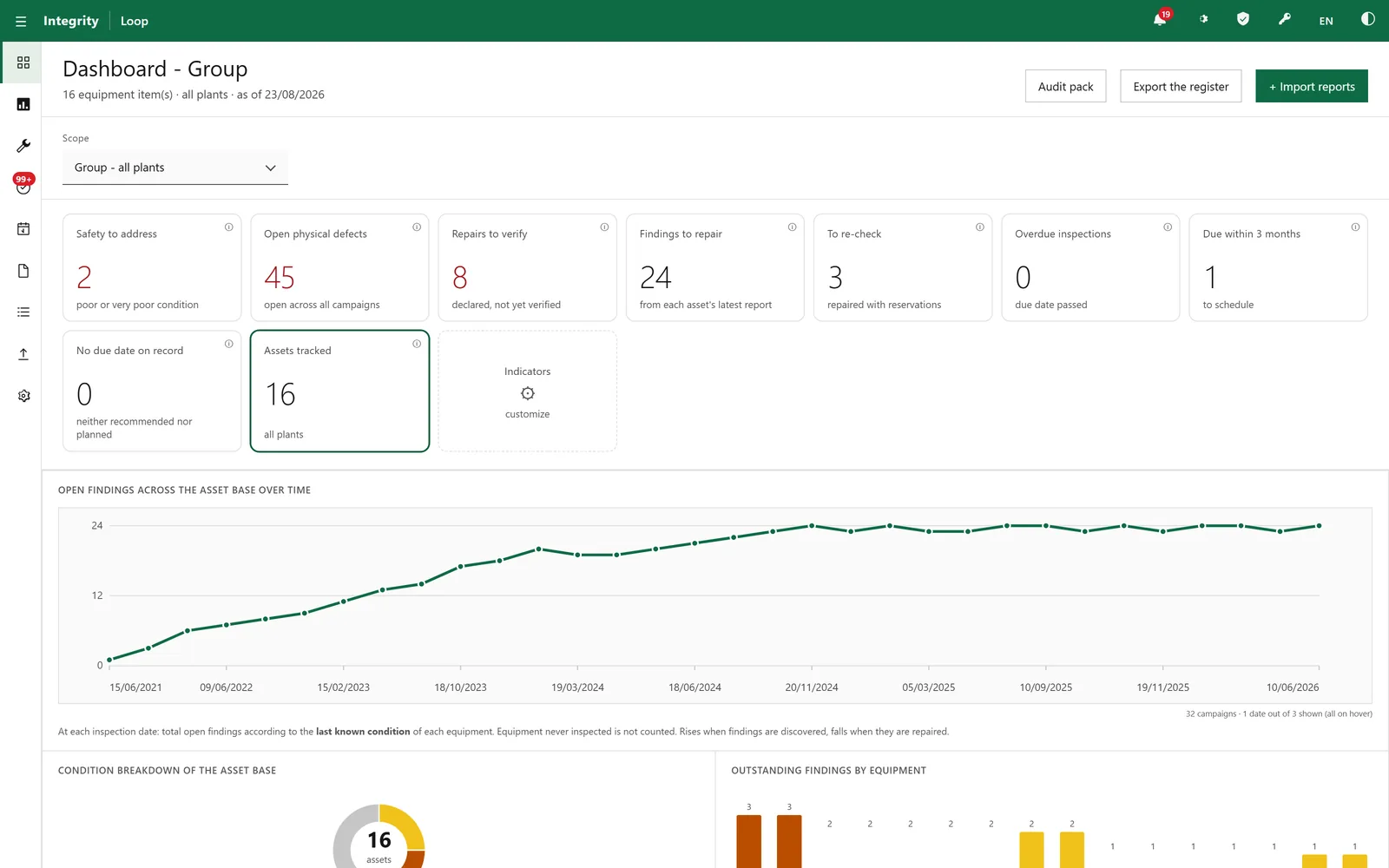
Integrity Loop consolidates your inspections, rebuilds the history of every asset and analyses how it evolves, helping you spot degradation, risks and the interventions that matter most.
Why?
In a plant, equipment condition directly affects production availability, product quality, safety, compliance and maintenance costs.
The goal is simple: know their condition, track how it evolves, and act before degradation becomes a costly industrial event.
Degradation that evolves without being identified early enough can cause a breakdown, an unplanned production stoppage, an emergency intervention or greater damage to the equipment.
In some processes it can also affect quality: loss of tightness, hygiene defects, contamination, foreign bodies or non-conformity that can lead to a product being blocked or recalled.
The signs of a future problem often exist well before the breakdown: cracks, corrosion, thickness loss, repeated anomalies, drifting measurements, successive repairs or open recommendations. Taken separately they seem minor; connected over time they reveal that equipment is degrading or that a situation is recurring.
Integrity tracking then answers essential questions:
The goal is not to artificially predict every breakdown, but to surface the signals early enough to better anticipate risk.
The information usually already exists. But it is spread across inspection reports, Excel files, network folders, work reports, photos, measurements, CMMS or documents from several providers.
The problem is not a lack of data. It is its fragmentation.
To truly understand an asset’s condition, teams need to connect: checks → findings → measurements → decisions → actions → repairs → next checks.
This continuity creates a genuine technical memory of the equipment and reveals how it evolves over months or years.
On a site with hundreds or thousands of assets, not every situation carries the same urgency. Maintenance, reliability, inspection and engineering teams need to quickly tell apart what is stable, what is evolving, what should be watched and what needs intervention.
Better visibility of the asset base notably helps to:
The point is not to produce more indicators, but to help teams decide where to act first.
An equipment problem can cost far more than the repair itself: production stoppage, capacity loss, scrap, delivery delay, emergency intervention or damage to other equipment.
In food, pharmaceutical and other sensitive industries, equipment integrity also has a direct consequence on the product: a crack, corrosion, surface deterioration or loss of tightness can contribute to contamination or non-conformity.
Mastering integrity therefore protects the equipment, production continuity and product quality at once.
During an audit, having the original report is not always enough. You need to demonstrate what was checked, what was found, which decision was made, which action was taken and whether the problem was then verified or closed.
Structured traceability makes internal, customer and group audits and compliance easier. It also helps identify in advance:
The goal: demonstrate that identified risks are tracked and controlled, without rebuilding the history from dozens of documents.
An equipment owner needs detail; industrial management needs the big picture. It must quickly understand:
This view better guides technical priorities, maintenance budgets, planned shutdowns and industrial investment.
For an industrial group the difficulty grows: each plant may use different providers, report formats, tracking methods and maintenance practices. A shared view of integrity helps to:
An anomaly identified locally thus becomes useful information for the whole group.
Integrity management is not only about managing inspections or storing reports. It turns the available technical information into a usable view: know the state of the asset base, understand how it evolves, detect risks, prioritise actions and demonstrate their follow-up.
With a concrete purpose: reduce unplanned downtime, protect product quality, strengthen compliance and give teams and management better control of equipment risk.
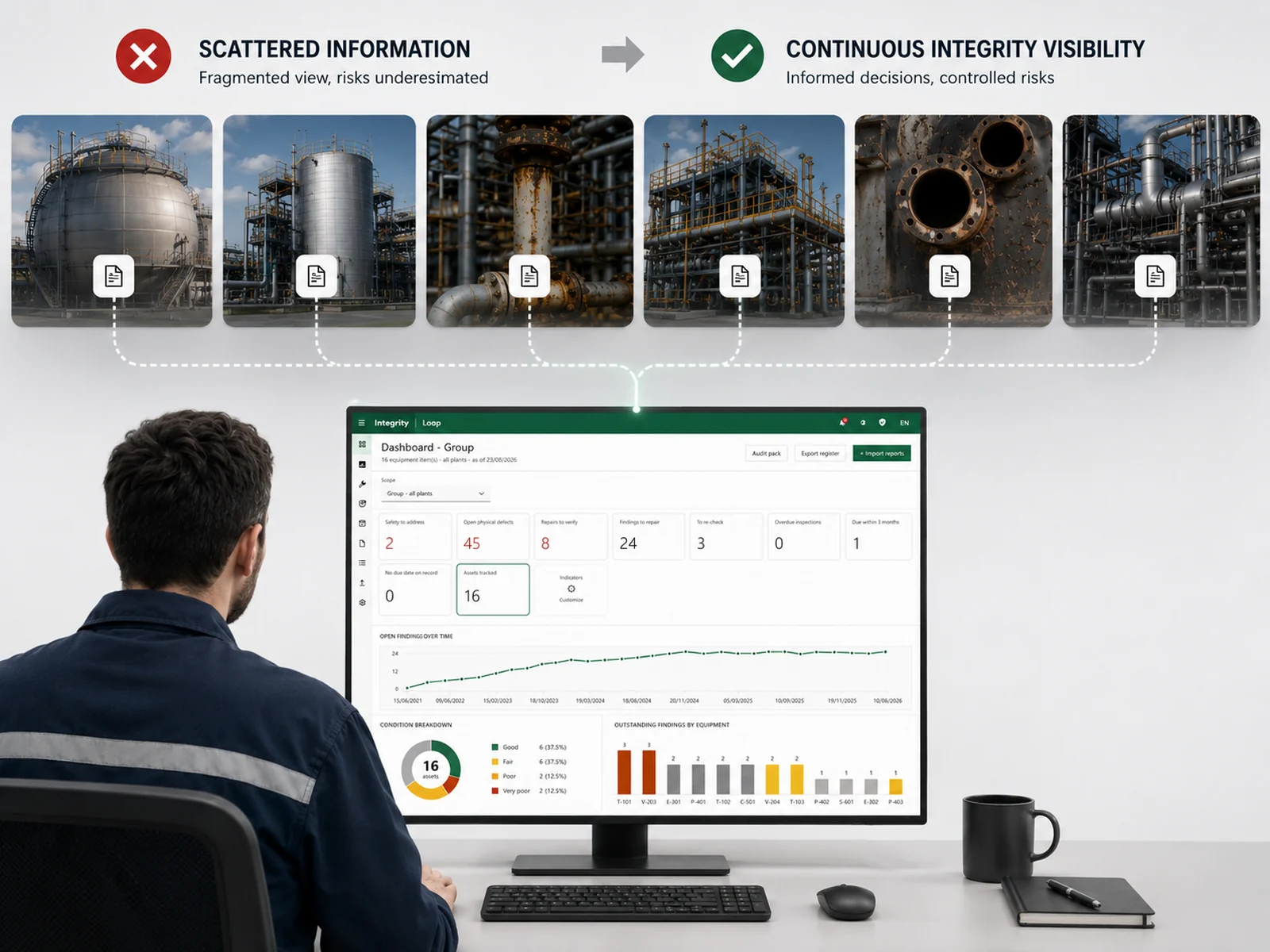
The transformation
Every imported report follows the same chain, all the way to a clear decision.
The platform
Integrity Loop turns successive inspections into continuous knowledge of your assets, to better understand their condition, anticipate degradation, prioritise actions and demonstrate their tracking over time.
Bring together inspections, findings, repairs, deadlines and history around each asset, whatever the site, provider or original format.
Get a clear view of the condition of each item of equipment and of the whole asset base, with its history and the changes observed across inspections.
Spot degradation, worrying trends and equipment needing closer monitoring earlier.
Help teams focus their inspections, interventions and investments on the assets that truly need attention.
Track upcoming deadlines, prepare inspection campaigns and organise actions from a consolidated view of the asset base.
Keep a structured history of inspections, findings, repairs and checks, to quickly retrieve what is needed for audits, internal reviews or controls.
At the scale of an asset, a plant or a multi-site group, turn inspection data into indicators useful for maintenance, integrity, quality and technical decisions.
Excel and PDF exports, instant search and audit-file preparation round out the platform.
How it works
AI analysis
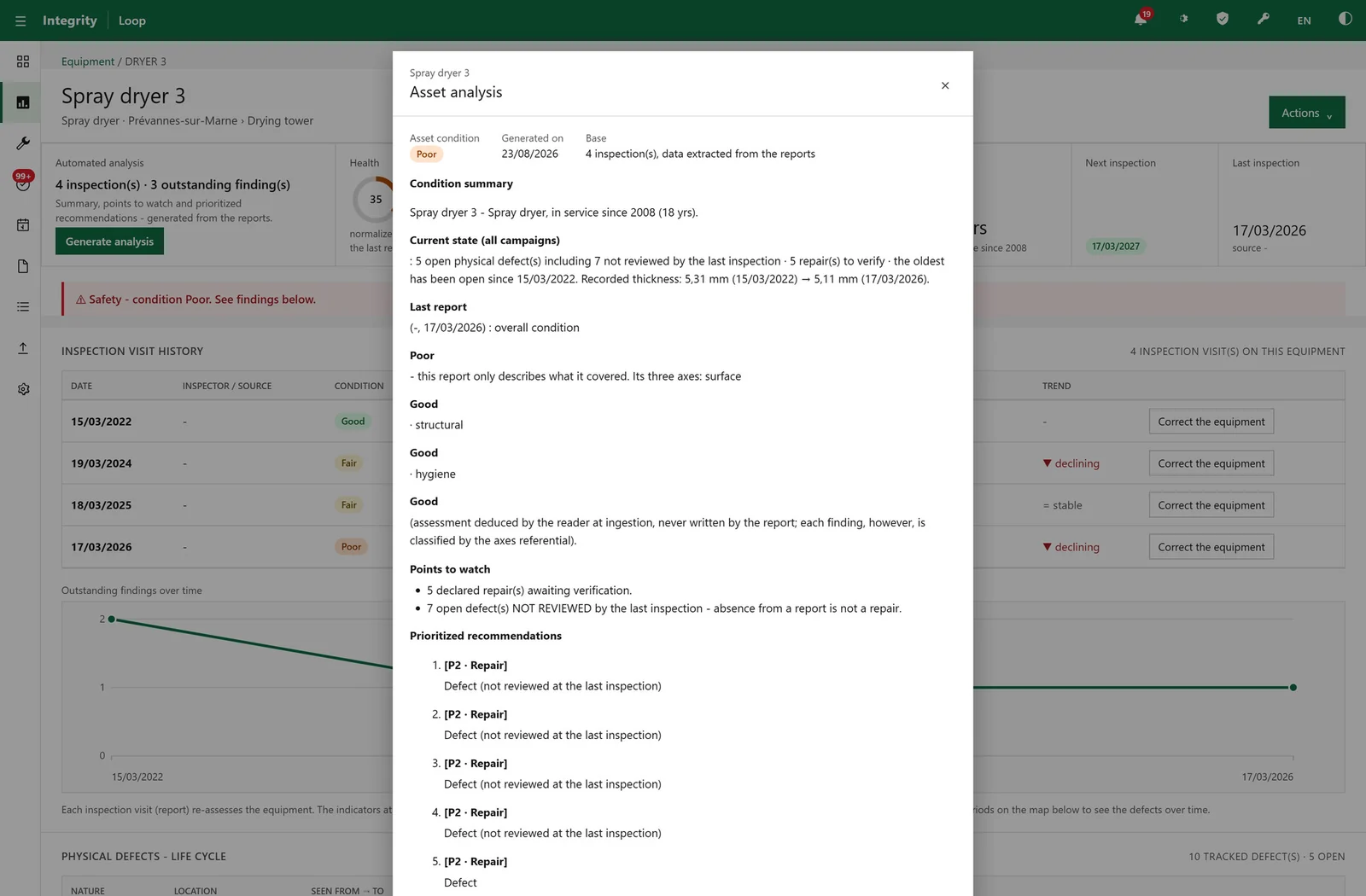
Integrity Loop does more than centralise your inspections. The AI analyses the history of your assets to surface significant changes, degradation and situations that need your attention.
A shared view
Track equipment condition, degradation, findings and actions.
Identify integrity-related risks and keep the evidence of tracking.
Compare equipment and sites to guide priorities and investment.
Integrity Loop works at the scale of a single item of equipment, a plant or a multi-site group.
In practice
Deployment & security
Reports and database on your own infrastructure.
Analysis possible without sending your data to a cloud AI service.
The data used stays linked to the asset and the corresponding inspections.
Data protection and recovery in case of error.
Integrity Loop does not replace your CMMS or EAM. It adds a layer specialised in making use of inspection data and tracking asset integrity. Your maintenance tools keep managing the work orders; Integrity Loop helps you understand the condition and evolution of the equipment that triggers them.
Cut the time spent rebuilding history and focus your teams on analysis and decisions.
Calculate the ROIYour licence
Pricing is sized to your asset base. Users, sites and history stay unlimited.
A licence sized to your asset base. Let’s find the setup that fits your asset base and your needs.
Discuss your asset baseFAQ
No. Integrity Loop makes use of the reports produced by your inspection bodies (non-destructive testing). It does not carry out the inspection: it structures it and tracks it over time.
The engine works with adapters: one report format equals one adapter calibrated on real documents. New bodies are added over time. An unsupported format is archived and flagged for calibration.
No. The database and the reports stay local on the workstation, with automatic timestamped backups. Deleting a report is reversible through restore.
Yes. Several reports, from several bodies and formats, can feed the same equipment. Identity matching is done in a validated way.
Integrity Loop turns inspection data into asset-integrity tracking, something asset-management suites do not do. It is a standalone software that coexists with an EAM already in place.
Stainless steel storage vessels, cyclones, drying towers and bag filters, in the food, pharmaceutical and medical industries.
Yes, from your real data. It tracks how defects evolve from one inspection to the next: nature, severity, location. The equipment that is degrading stands out. You schedule repairs before production stops. Every alert is based on your reports.
The ability of a piece of equipment to operate safely and at the expected performance throughout its life. Managing it means tracking the real condition of each asset over time, from inspections.
A set of techniques (ultrasonics, dye penetrant, radiography, etc.) that assess the condition of equipment without damaging it. Each test produces a report that Integrity Loop structures and uses.
Reference inspection codes. API 510 covers pressure vessels, API 570 piping, API 653 storage tanks. Integrity Loop structures findings in line with these frameworks.
An approach that prioritises inspections according to the risk of each item of equipment. Integrity Loop feeds it by making the condition and evolution of each asset visible.
No. Integrity Loop installs and runs locally, on your workstation or your network. Your inspection data stays on your network.
Importing and reading a first batch of reports is immediate. A new format needs an adapter, calibrated on your real documents.
Yes. The dashboard can be viewed by group then by site, with indicators computed over the chosen scope.
Local database off the cloud, automatic timestamped backups, one-click deletion and restore. Your reports stay with you.
No. It extracts what is written in the report. Missing data is flagged as such.
Yes. The audit file for an item of equipment or a site can be exported, and the data is available as CSV.
Food, pharmaceutical and medical: sectors where equipment integrity and traceability are critical.
No. Your bodies carry out the tests. Integrity Loop structures the data and tracks it over time.
Just ask: we will present Integrity Loop and answer your questions. Contact us.
See Integrity Loop in real conditions, and how it turns hundreds of inspections into a clear, actionable view of your equipment.
Request a demoIntegrity Loop is designed and published in France by Assets 4.0. Founder: the Assets 4.0 team · Published on , updated on · Write to us.
Quick contact
Solutions
Assess and manage the integrity of your equipment from your inspection reports.
IDMSTurn the findings inside reports into an actionable, per-asset condition history.
ReportsCentralize scattered PDFs and link them to the right equipment, ready to exploit.
 AI for industry
