
IFS and BRCGS audit
Which equipment does an IFS or BRCGS auditor check?
Most quality managers ask themselves this three weeks before the audit. Here is the equipment involved, risk zone by risk zone, with the evidence the auditor will ask for on each one.

An IFS or BRCGS auditor judges your ability to prove your equipment is under control. The equipment involved falls into four risk zones: filtration and process, packaging, foreign-body detection, and utilities.
For each one, the expected evidence is the same in principle: a dated record covering the whole audited period. You also need a traced course of action when a result is non-compliant.
A major non-conformity most often lands on a missing record. Or on a defect you cannot place in time. Rarely on the defect itself.
The four risk zones and their equipment
This list covers the equipment whose failure can reach the product. It applies to sites certified to IFS Food and BRCGS Food, that is, to processing and manufacturing.
Filtration and process
This equipment holds back what must not reach the product. You will not see it fail by looking at it. You have to test it.
- Liquid filters
- Membranes and cartridges on process water, milk, wine and syrups. Integrity is verified by bubble point or by pressure drop, and the result must be recorded.
- Air filters and vents
- HEPA filters and sterile-tank vents. They protect against microbiological contamination of the air, both in the room and on the packaging lines.
- Heat exchangers
- Plate and tube types. A micro-leak test demonstrates that there is no mixing between heat-treated product and raw product. It is one of the most closely watched points in pasteurisation.
Packaging
If the seal integrity of the packaging is not proven, the product's stated shelf life becomes contestable. And with it, the labelling.
- Heat sealers and lidding machines
- Peel strength and vacuum-chamber leak test, depending on the type of packaging. Records must cover the audited period, not just the day before the audit.
- Container rinsers and blowers
- Verification that debris is removed before filling, and rinse compliance.
Foreign-body detection
On this equipment, the auditor looks less at the hardware than at the log of checks that goes with it.
- Metal detectors and X-ray systems
- Verification with calibrated test pieces (ferrous, non-ferrous and stainless), plus glass for X-ray. The frequency is set by your food-safety plan, typically at start-up, at batch change and at a defined interval. What is checked in an audit is the regularity of the records and the action taken when the test fails.
- Sieves and mechanical filters
- Inspection of the mesh for tears. A holed sieve is a source of foreign bodies, and the absence of an inspection record is a gap in itself.
- Magnets
- Pull test to check that the magnetic force is maintained, and recording of the particles removed.
Utilities and environment
Because utilities do not touch the product, they often drop off the control plans. Auditors ask for them anyway.
- Reverse osmosis and water treatment
- Conductivity monitoring reports on membrane integrity. An unexplained drift is a signal.
- Condensate traps and drains
- Standing water in a production area is fertile ground for Listeria monocytogenes. The check covers both operation and its traceability.
You already know this list. What takes time is finding the evidence for each line, inside your contractors' reports.
See the evidence in one clickWhat tips a finding into a major non-conformity
An auditor compares your claims with your evidence. Four situations tip a finding over:
- The record is missing over a period. Three weeks with no trace of a metal-detector check, and the auditor will ask you what went out for dispatch during that time. A log filled in the day before is just as quick to spot: same pen, same handwriting, same day.
- An earlier gap has no traced follow-up. An inspection report flags a defect, and nothing shows what was decided or done. This is the most common case.
- The original report cannot be found. You state that a check took place, without being able to produce the contractor's document.
- The defect cannot be placed in time. Without a history, you cannot say whether corrosion has been stable for two campaigns or whether it is progressing. Neither can the auditor, and it is the auditor who decides.

Where IFS and BRCGS apply
IFS Food and BRCGS Food cover the processing and manufacturing of food products. That is where the process equipment described on this page is found. It is also the scope where integrity evidence is the most demanding.
IFS Logistics and BRCGS Storage & Distribution cover storage and transport. The expectations exist, but they concern other equipment: the cold chain, docks and handling equipment.
IFS Broker addresses trading and resale without direct handling of the product. With no process equipment, the demonstration is about supplier selection and monitoring.
Rebuilding this evidence without spending a week on it
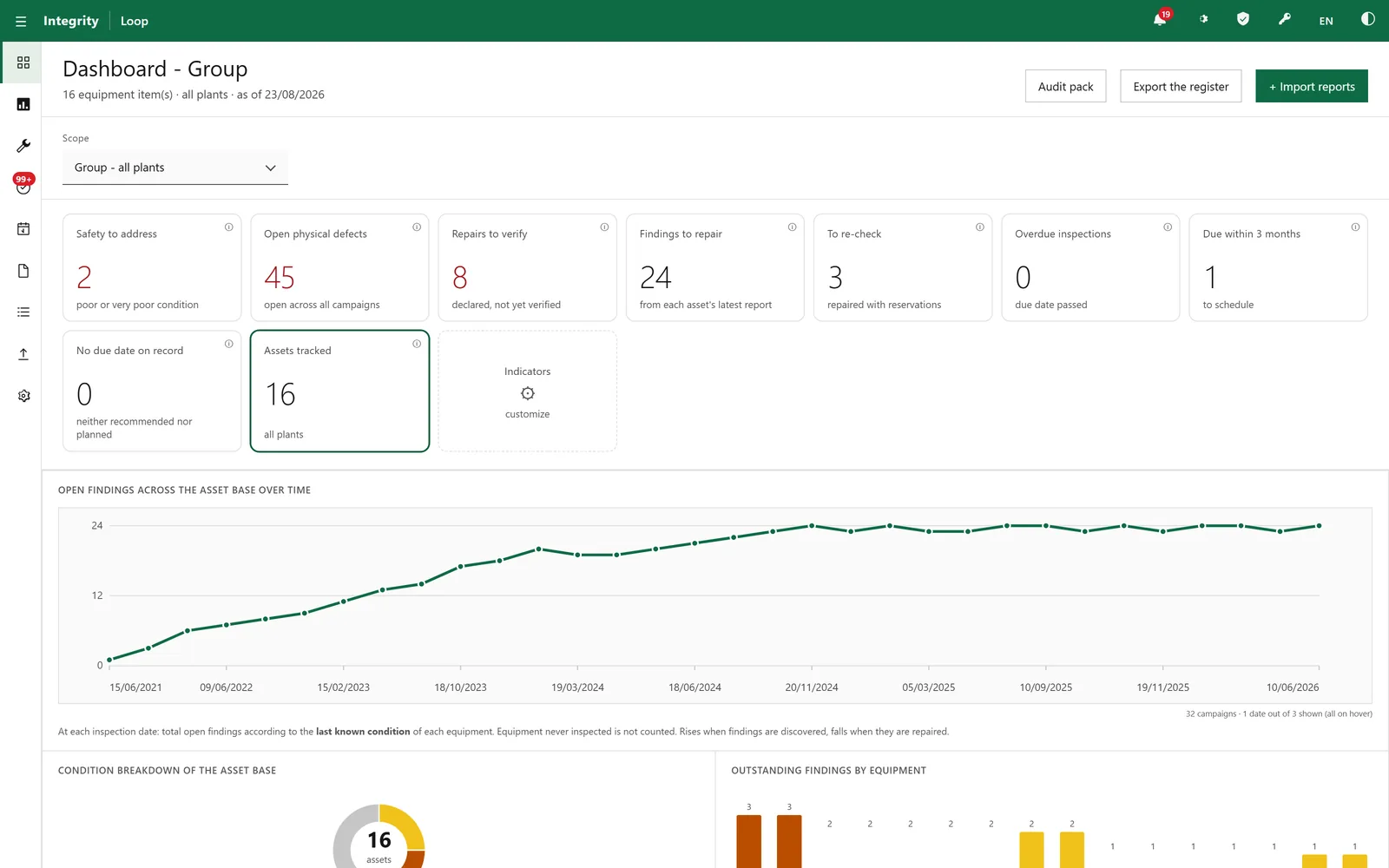
Your evidence already exists: inspection reports, contractor write-ups, verification records. It lives in network folders, binders and inboxes, with nothing tying it to the equipment concerned. That is where the days before an audit are lost.
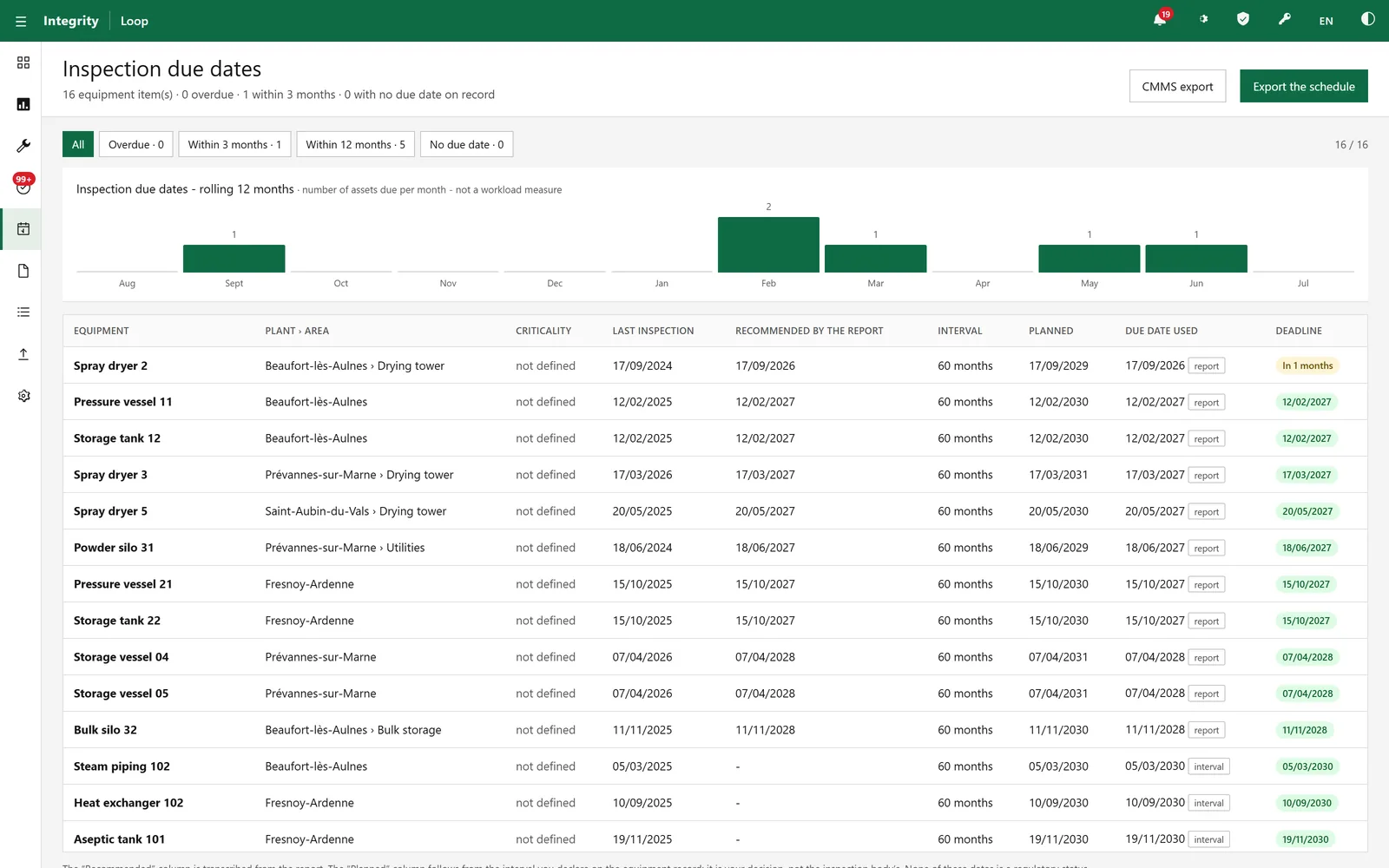
Integrity Loop analyses your inspection reports in PDF, locally. It rebuilds a single history for each piece of equipment: the findings and how they change from one campaign to the next. It also holds the deadlines and the link to the original report.
When the auditor asks for the evidence on a piece of equipment, it is produced by that equipment, with its source.
The software does not produce findings of its own. It transcribes what your contractors wrote. Formats it cannot read are flagged.
Frequently asked questions
Which equipment is checked during an IFS or BRCGS audit?
The auditor checks the equipment whose failure can reach the product. That covers liquid and air filters, heat exchangers, sealers and lidding machines. It also covers metal detectors and X-ray systems, sieves, magnets, and utilities such as water treatment. What they assess is your ability to prove that the integrity of each one is verified and recorded.
What evidence must be provided for a metal detector?
The verification records made with calibrated test pieces, across the whole audited period, at the frequency defined by your food-safety plan. The auditor also checks what you do when a test fails. They expect identification of the products affected since the last passing test, a hold, and a traced decision.
What turns a finding into a major non-conformity?
Rarely the defect itself. It is the absence of evidence, or the record missing over a period. It is also the gap flagged at an earlier check with no traced action, or the original report you cannot retrieve. A known defect that is monitored and documented keeps you in control of the discussion. Without a history, you are left with the auditor's conclusion.
Do IFS and BRCGS ask for the same thing on equipment?
Both standards start from the same principle: you control what you can demonstrate. IFS Food and BRCGS Food cover processing and manufacturing, where this equipment is found. IFS Logistics and BRCGS Storage & Distribution cover storage and transport. IFS Broker covers trading without handling. Expectations for process equipment differ.
How long does it take to gather this evidence before an audit?
It depends on where your reports live. Inspection reports, contractor write-ups and verification records are often scattered across network folders, binders and inboxes. Rebuilding them then takes several days of quality work. A record kept per equipment brings that reconstruction down to a search by equipment.
- Your reports stay with you. The software installs on your own machines, and your reports stay there.
- Nothing is interpreted. An unsupported format is flagged rather than guessed.
- Every finding keeps its source. The original report is one click away, on the right page.
- Unlimited users and sites. Quality, maintenance and management see the same status.
Your next audit is prepared equipment by equipment.
We show you the software on real inspection reports, and the history it rebuilds for each piece of equipment.
Request a demo